

PagerDuty and Blue Triangle Integration Benefits
-
Send real time alerts from Blue Triangle based on performance and business data collected from Real User Monitoring, as well as site performance and availability from Synthetic Monitoring
-
Incidents are updated within both PagerDuty and Blue Triangle, including automatically resolving open incidents
How it Works
-
Blue Triangle alerts that trigger based on configured rules will send an event to a service in PagerDuty. A new incident will open on the corresponding PagerDuty service. All information relevant to the Blue Triangle alert will be available in the PagerDuty incident.
-
Once the alert has returned to a Clear state in Blue Triangle, a resolve event will be sent to the PagerDuty service to resolve the alert, and the associated incident on that configured service.
Requirements
-
PagerDuty integrations require the Department Viewer role assigned to the correct department for the site you wish to add the integration to. If you do not have this role, please reach out to an Account Admin within your organization to configure the integration.
Support
If you need help with this integration, please contact support@bluetriangle.com
Integration Walkthrough
In PagerDuty - Integrating With a PagerDuty Service
-
From the Configuration menu, select Services.
-
There are two ways to add an integration to a service:
-
-
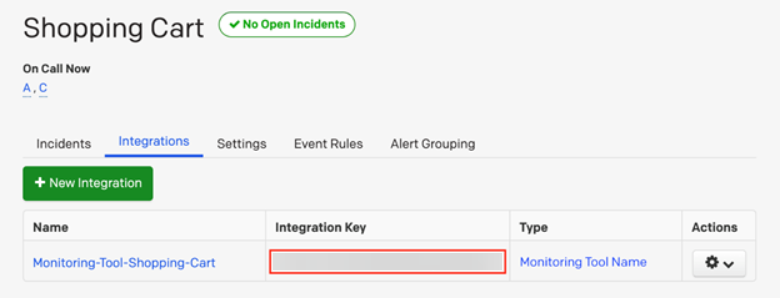
If you are adding your integration to an existing service: Click the name of the service you want to add the integration to. Then, select the Integrations tab and click the New Integration button.
-
If you are creating a new service for your integration: Please read our documentation in section Configuring Services and Integrations and follow the steps outlined in the Create a New Service section, selecting Blue Triangle as the Integration Type in step 4. Continue with the In Blue Triangle section (below) once you have finished these steps.
-
-
Enter an Integration Name in the format monitoring-tool-service-name (e.g. Blue Triangle -Shopping-Cart) and select Blue Triangle from the Integration Type menu.
-
Click the Add Integration button to save your new integration. You will be redirected to the Integrations tab for your service.
-
An Integration Key will be generated on this screen. Keep this key saved in a safe place, as it will be used when you configure the integration with Blue Triangle in the next section.
In Blue Triangle
-
Log in to the Blue Triangle Portal
-
Click the Gear Icon in the upper right-hand corner to open Settings & Administration
-
Search for Notification Groups in the search box
-
Click on Notification Groups
-
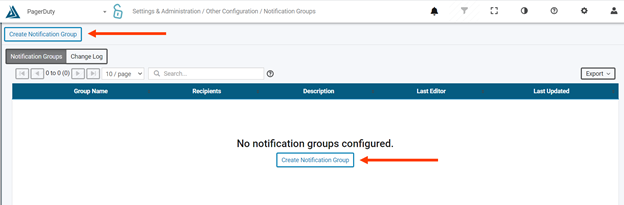
Click Create Notification Group or Update an already existing group
-
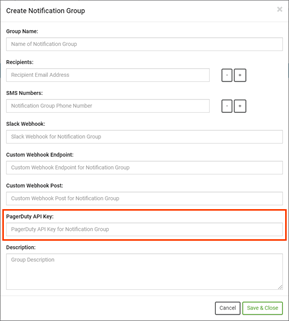
Add your PagerDuty integration key from the steps above to the PagerDuty API Key
-
Click Save & Close
-
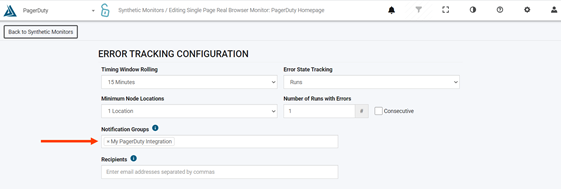
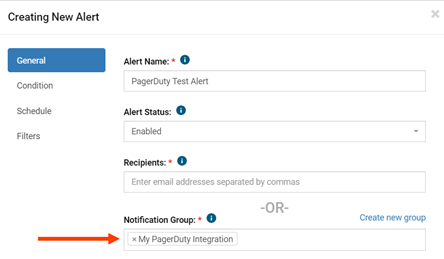
Once the Notification Group has been configured with the PagerDuty integration key, you can assign this Notification Group to all available alerting systems in Blue Triangle
-
Note: User must have access privileges to modify Alerts or Synthetic Monitors, contact your Department Administrator for access
-
Synthetic Error Tracking Alerts located under Synthetic Monitors
Rule Based Alerts located under Alerts
-
Once assigned Click Save & Close under the respective section to assign the Notification Group to the Alert or Synthetic Monitor
How to Uninstall
-
Log in to the Blue Triangle Portal
-
Click the Gear Icon in the upper right-hand corner to open Settings & Administration
-
Select Notification Groups listed in the Other section
-
Click Update an already existing group and remove the PagerDuty API Key, or click Delete to remove the Notification Group
-
Alternatively, the Notification Group containing the PagerDuty integration key can be removed from the Notification Group section within the Alert or Synthetic Monitor